The Blueprint for Future-Proof Education: Unlocking the AI Polymath Within
TL;DR: Future-proof education rests on three things that don’t expire: learning how to learn, fluency with AI, and building real things. Here’s the blueprint, and why it matters as 39% of core skills change by 2030.
What makes education future-proof?
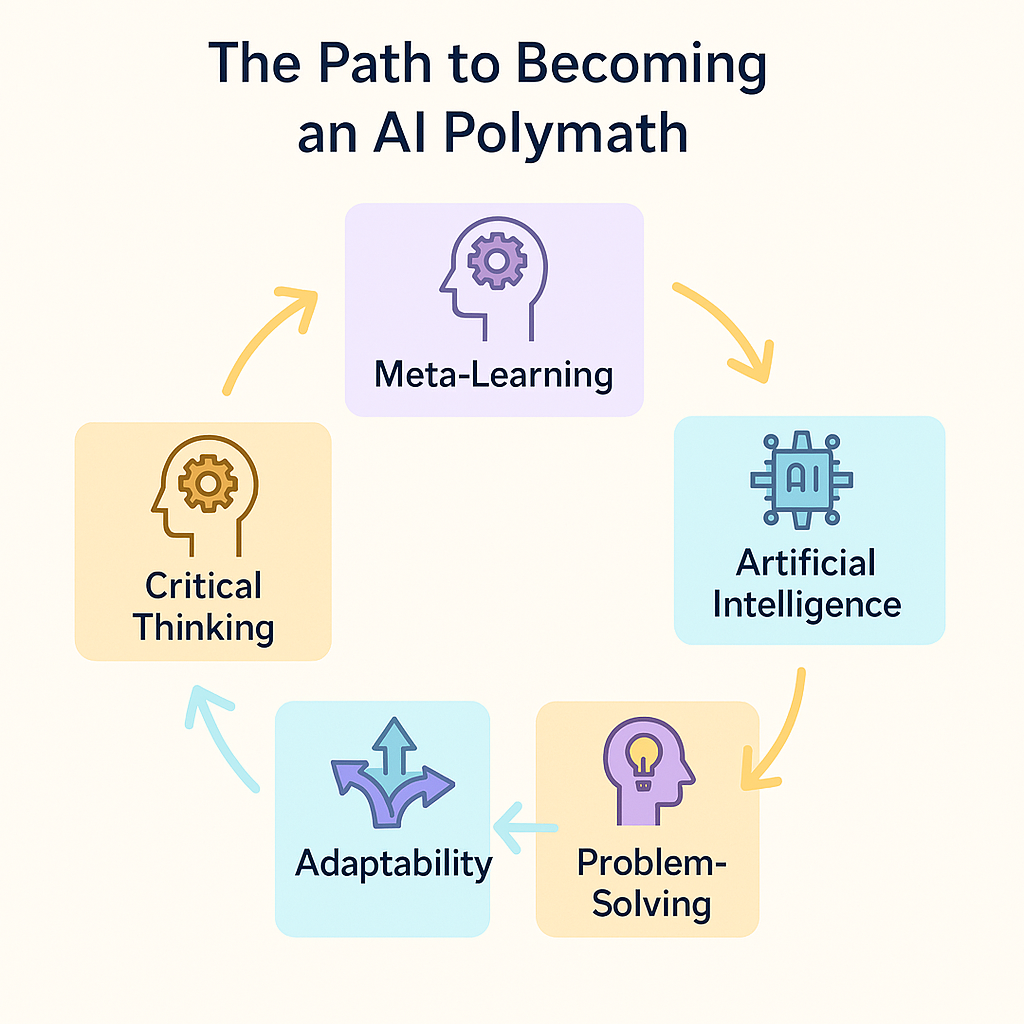
Education is future-proof when it trains the things that outlast every tool, not this year’s version of the tool. Three foundations do that. Meta-learning — learning how to learn — so you can keep absorbing new fields as they appear. Fluency with AI, including AI orchestration: directing AI toward a real outcome and knowing when its answer isn’t good enough. And building real things, because the durable skills only form when you apply them under real constraints and get honest feedback. The World Economic Forum projects 39% of core skills will change by 2030, so any education built around a fixed body of content is aiming at a target that’s already moving. One built around these three foundations produces people who adapt — the kind of learner who treats a new tool as a Tuesday, not a crisis. That’s the difference between surviving the AI era and compounding through it.
Introduction: Beyond Survival—Thriving in the AI Era
Education as we know it is fundamentally obsolete. Artificial Intelligence isn’t merely automating routine tasks; it’s shifting the very definition of human capability and potential. Institutions that stick to traditional knowledge transfer will fade into irrelevance. The future demands a fundamental shift toward developing highly adaptable, deeply reflective learners—AI Polymaths—who possess cognitive agility and intellectual versatility far beyond memorized facts.
Three Essential Pillars of Future-Proof Education
1. Meta-Learning: The Cognitive Advantage
Meta-learning, or “learning how to learn,” transforms education from passive consumption into an active and strategic practice. It empowers students to rapidly master diverse domains, enhancing their ability to pivot seamlessly in response to constant change.
- Implementation: Reflective journaling, continuous self-assessment loops enhanced by AI feedback, and adaptive learning pathways.
- Impact: Immediate applicability to real-world challenges, enabling professionals to move fluidly between careers, staying consistently relevant.
2. AI Fluency: Mastering the Human-AI Partnership
True fluency with AI transcends knowing how to prompt a tool. It involves deeply understanding when, why, and how to collaborate intelligently with AI systems—making informed decisions around ethics, data bias, and strategic use cases.
- Implementation: Practical workshops in sophisticated AI prompting techniques, real-world AI projects, scenario-based ethical explorations.
- Impact: Graduates capable of leading AI projects, innovating solutions, and critically assessing AI-driven strategies, thereby enhancing their strategic organizational value.
3. Real-World Application: Learning Through Creation
Theoretical knowledge alone is insufficient. Education must be a laboratory where learners continuously apply skills to authentic challenges, building concrete outcomes that demonstrate clear value.
- Implementation: Project-based learning initiatives, direct industry collaborations, real-world problem-solving simulations.
- Impact: Students graduate with robust portfolios, tangible outcomes, and demonstrable evidence of their skills and creativity.
Adapting the Future-Proof Model Across Educational Systems
K-12 Education
Transition from rote memorization to holistic inquiry-based learning, embedding critical thinking, creativity, and collaborative problem-solving directly into curricula.
- Example: Finland’s Phenomenon-based Learning, fostering interconnected and contextualized understanding.
Higher Education
Radical reimagination of traditional degrees into flexible, interdisciplinary modules supported by AI mentorship and micro-credentials tailored for evolving job market demands.
- Example: Minerva University’s interdisciplinary model, providing global exposure, rigorous skill training, and deep adaptive learning.
Corporate Learning and Development
Transform corporate training into agile learning ecosystems, driven by real-time AI insights and continuous adaptability, focused on cultivating intrapreneurial mindsets and skill fluidity.
- Example: Amazon’s Career Choice program, emphasizing lifelong, AI-enhanced learning aligned with market demands.
Strategic Implementation: Recommendations
For Institutions:
- Integrate meta-learning frameworks deeply across curricula.
- Develop robust AI literacy and critical usage programs.
- Forge direct, meaningful industry partnerships for practical relevance.
For Individuals:
- Engage regularly in structured skill and cognitive agility assessments.
- Curate dynamic “skill-portfolios” highlighting adaptable capabilities.
- Embrace AI mentorship platforms (like Lemma Alpha) for sustained growth and guidance.
For Companies:
- Embed agile and adaptive learning systems emphasizing meta-skills and AI collaboration.
- Create internal innovation hubs to foster intrapreneurship.
- Leverage AI analytics for proactive employee skill development.
Conclusion: A Call to Action—Forge Your AI-Driven Future
The future isn’t about predicting outcomes; it’s about proactively shaping possibilities. By adopting this future-proof education blueprint, we are not just adapting—we’re transforming individuals into visionary AI Polymaths capable of navigating and mastering complex futures. Lemma Alpha stands at the forefront, guiding institutions, individuals, and organizations to not merely survive—but to thrive and innovate boldly in the AI era.
Ready to awaken the AI Polymath in you or your organization? Discover transformative learning paths at Lemma Alpha today.

Written by
Massih MediMassih Medi is a physicist-turned-entrepreneur and founder of Lemma Alpha, an AI-powered education platform equipping learners with future-proof skills for the post-AI era. He's focused on education designed for the artificial super intelligence era, providing students with AI-driven critical skills training tailored for the evolving job market. He also leads D&C Innovation, where he guides software engineering teams in building and maintaining applications for tech startups, leveraging his scientific background to design and architect complex digital solutions.